
 Logout
The Hon. R. Roy McMurtry
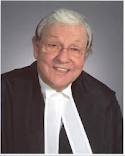
This comprehensive oral history interview with Roy McMurtry covers his distinguished career in Canadian law and politics, spanning from his early family background in Toronto through his transformative roles in Ontario’s legal system. Born in 1932, McMurtry emerged from a business family background to become one of Canada’s most influential legal figures, serving as Ontario’s Attorney General from 1975-1985 and later as Associate Chief Justice and Chief Justice of Ontario from 1991-2007.
As Attorney General under Premier Bill Davis, McMurtry played a pivotal role in Canada’s constitutional development, working alongside Roy Romanow and Jean Chrétien as a key architect of the 1981 constitutional accord and Charter of Rights and Freedoms. His tenure was marked by significant legal reforms including court administration modernization, the expansion of legal aid clinics, enhanced race relations initiatives, and the controversial extension of separate school funding to Grade 12 in 1984. Throughout his career, McMurtry demonstrated a commitment to judicial independence, diversity in appointments, and access to justice, while managing complex constitutional challenges and federal-provincial relations during critical periods in Canadian history.
This description was written by AI and may contain some inaccuracies.
References
The following are a selection of topics discussed in this oral history.
- County Courts
- Court of Queen's Bench
- District Court
- Divisional Court
- Family Court
- Federal Court
- Federal Court of Appeal
- High Court of Ontario
- Old Bailey
- Ontario Court of Appeal
- Provincial Courts
- Supreme Court of Canada
- Unified Family Court
- Osgoode Hall Law School
- Department of Justice
- House of Commons
- Management Board
- Ministry of the Attorney General
- Ontario Police Commission
- Parliament
- Parti Québécois
- Progressive Conservative Party
- Treasury Board
- Charter of Rights and Freedoms
- Constitutional patriation 1981
- Court Merger 1990
- Great Depression
- KKK march in Toronto 1980
- October Crisis
- Official Languages legislation backlash
- Quebec Referendum 1980
- Separate School Funding Extension 1984
- Victoria Conference 1971
- War Measures Act
- Alberta
- British Columbia
- Canada
- London Ontario
- Manitoba
- New Brunswick
- Newfoundland
- Nova Scotia
- Ontario
- Ottawa
- Prince Edward Island
- Quebec
- Saskatchewan
- Toronto
- United Kingdom
- United States
- ADR Chambers
- Goodman and Goodman
- Tory, Tory
- Anti-Inflation Reference
- Askov decision
- Bernardo case
- Constitutional Reference 1981
- Reference re Residential Tenancies Act
- Susan Nelles case
- Judge
- Ministers of Justice and Attorneys General
- Ministry of the Attorney General
- Ontario Court of Appeal
- Alan Blakeney
- Albert Johnson
- Allan Lawrence
- Arthur Martin
- Bill Davis
- Bob Rae
- Bora Laskin
- Brian Dickson
- Brian Mulroney
- Charles Dubin
- David Duke
- David Peterson
- Frank Callaghan
- Ian Scott
- Jean Chrétien
- John J. Robinette
- John Morden
- Lloyd Perry
- Lorenzo DiCeccio
- Margaret Campbell
- Peter Lougheed
- Pierre Trudeau
- René Lévesque
- Robert Bourassa
- Rosie Abella
- Roy McMurtry
- Roy Romanow
- Sam Grange
- Sid Linden
- Stephen Lewis
- Big Brothers of Metropolitan Toronto
- Canadian Bar Association
- Canadian Judicial Council
- Folk Arts Council
- Frontier College
- Law Society of Ontario
- Ontario Judicial Council
- Ontario Law Reform Commission
- St. Leonard's Society
- The Advocates' Society
- 1930s
- 1970s
- 1980s
- 1990s
- Case Management
- Charter of Rights and Freedoms
- Civil justice
- Constitutional Law
- Constitutional patriation
- Court Administration
- Court Security
- Criminal Law
- Family Law
- Federal-Provincial Relations
- French Language Rights
- Hate Crimes
- Judicial Appointments
- Judicial Conduct
- Judicial Independence
- Landlord and Tenant Law
- Legal Aid
- Race Relations
- Residential tenancy tribunals
- Separate School Funding
Some of these references were generated by AI and may contain inaccuracies.